
NBME 30
NBME 31
UWSA 2
Free 120
Combine Supported Assessments
Review supported CCSSA, UWSA 1/2, Free 120, and AMBOSS results in one prediction while keeping each assessment family distinct.
Combine compatible CCSSA, UWSA, or Free 120 scores into an independent Step estimate with an estimated planning range. Review the assumptions before using it for a test-date decision.
Add your scores. See your range instantly. No signup.
Select your exam
Your practice exams
No signup required. Calculate clicks are logged to measure and improve the funnel; see Privacy for retention details.
A combined estimate, an explicit planning range, and the assumptions needed to interpret both.
Review supported CCSSA, UWSA 1/2, Free 120, and AMBOSS results in one prediction while keeping each assessment family distinct.
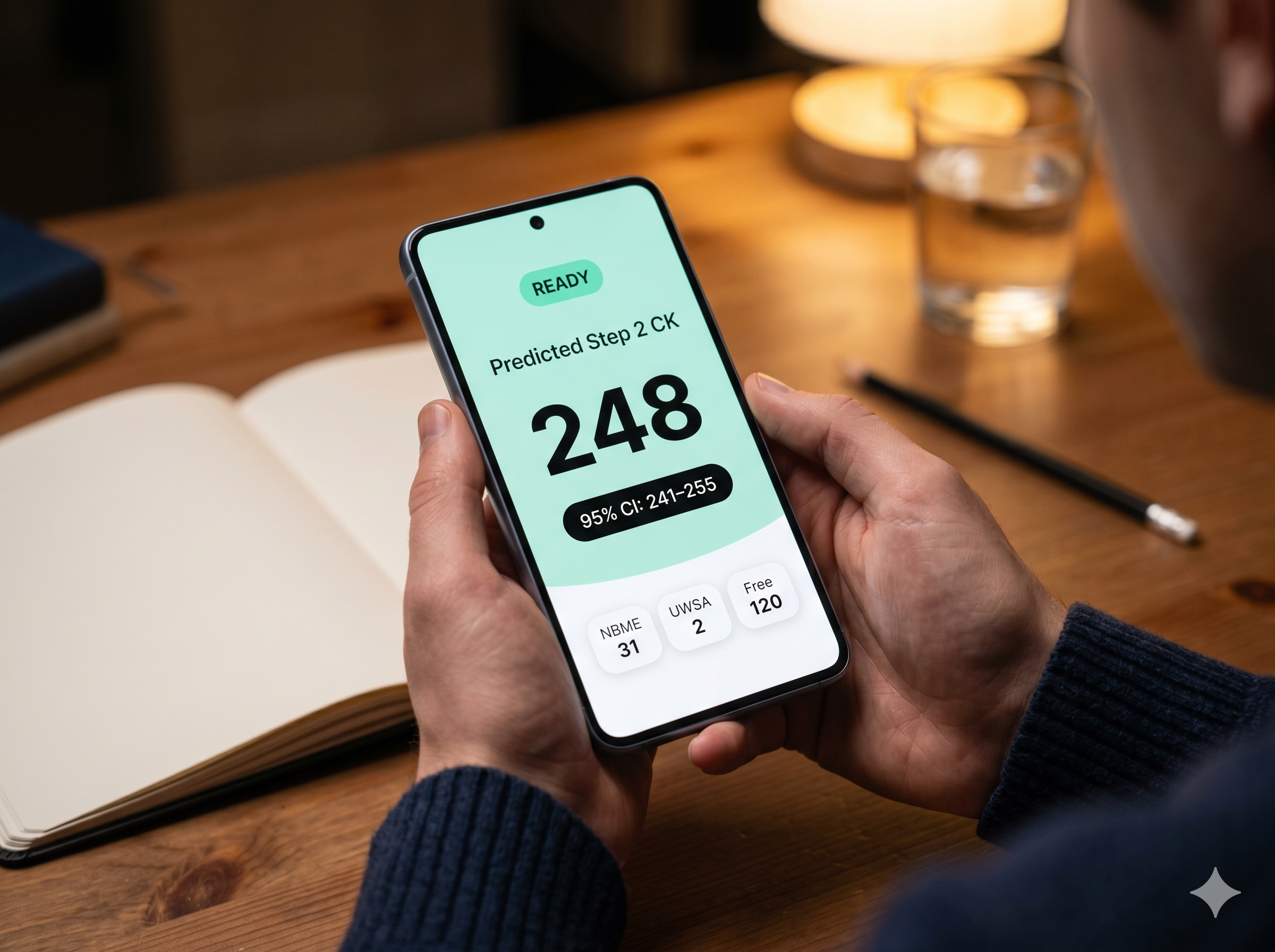
We show an estimated planning range beside the midpoint and publish how it is produced. It is an internal heuristic, not a validated 95% interval.

The free result keeps your estimate, planning range, and assumptions visible. Optional reports package personalized priorities for saving or printing.
The calculator exposes its assumptions and uncertainty. We do not claim a validated cohort until a reproducible dataset and holdout report are published.
Three steps. Five seconds. No paywall to see your range.
Collect compatible CCSSA, UWSA, Free 120, or AMBOSS results you want to review together.
No signup or email is required. Choose the exam step first so the calculator can show the compatible form and score options.
See your point estimate and estimated planning range instantly. Keep using the calculator for free; printable reports and saved tracking stay optional.
Before you rely on a predictor
Predictor feature lists change and do not establish accuracy. These are the four checks NBMEcalc exposes so you can judge the result on its evidence and limitations.
Combine supported CCSSA, UWSA, Free 120, and AMBOSS results while keeping each assessment family distinct.
The free result includes a midpoint and model-generated planning range. It is not a verified 95% interval or an official score report.
Source adjustments, recency weighting, known limits, and material corrections are documented in the public methodology.
High-stakes scheduling decisions should be checked against official assessment feedback and your school or advisor's process.
We don't just predict — we explain assumptions, link official sources, and keep unreviewed drafts out of search until their claims can be checked.
Ready to run your scores? Go straight to the Step 1 predictor or the Step 2 CK predictor. Not sure which assessment family you took? Start with the NBME self-assessment forms and score guide.
To get you started, here are our top guides:

NBME lists 8 CMS subjects and multiple forms per subject, but no stable public total. Learn how to check current availability and choose what to take.
Read more
Learn how official USMLE CCS software handles orders, simulated time, location, monitoring, case endings, and sample-case feedback.
Read more
Build a Step 2 CK review order from current USMLE system and physician-task ranges instead of an unverifiable list of recalled questions.
Read moreNBMEcalc currently uses an internal editorial process. We do not claim named physician review until reviewer identities and scope can be verified publicly.
Assessment families, score-report guidance, and passing standards are checked against current NBME and USMLE pages.
Material assumption changes are documented publicly. Stored predictions keep their algorithm version.
Readers can report factual or calculation concerns. Unsupported claims are corrected or removed rather than defended.
Read the public methodology and changelog or submit a correction.
Updated August 7, 2026
Practical, source-checked guides for Step planning. No filler and no unsupported certainty.

Compare the Step 2 CK features each product currently documents, then choose by study workflow, remaining time, and the resources you already own.

A practical USMLE test-day checklist built around the official permit, identification, security, belongings, and break rules.

Use the official USMLE system, physician-task, and clinical-science ranges to prioritize Step 2 CK review without inventing a fixed topic list.

A source-backed guide to reading current CBSSA and CCSSA score reports without mixing Step 1 EPC, Step 2 CK total scores, score ranges, or pass probabilities.
Optional upgrades add downloadable reports, saved history, and long-term Step tracking. You do not need a plan to calculate your score and review its planning range.